
A car accident lawyer free consultation is a no-cost meeting where you describe your crash and a lawyer tells you whether you have a claim worth pursuing. Nothing is signed unless you choose to sign it, and there is no bill either way.
Most people picture something more formal than it is. There is no test and no obligation. The American Bar Association puts the usual contingency percentage at one-third to 40 percent, the Texas Department of Insurance sets the state’s minimum liability coverage at 30/60/25, and the Insurance Information Institute reports 14.5% of Texas motorists carried no insurance at all in 2023. Those three numbers shape almost every answer you will hear in the room.
This guide covers what gets asked, what to bring, the questions worth asking back, how the fee works, what kind of crash you had, and how to tell a useful consultation from a sales pitch.
If you are reading this a few days after a wreck, you are probably sore, behind on everything, and getting calls you did not ask for. That is a normal place to be and it is not a sign you have done anything wrong. You do not have to decide anything today.
Is a car accident lawyer free consultation actually free?
Yes. A car accident lawyer free consultation means no charge for the meeting, whether or not you hire the firm afterward. You do not get a bill, and showing up commits you to nothing.
The confusion comes from mixing up two separate things:
- The consultation is the conversation. It is free.
- The fee agreement is a document you would sign only if you decide to hire the firm.
Injury firms are typically paid through a contingency fee, meaning a percentage of what you recover and nothing if you recover nothing. The American Bar Association describes that percentage as often one-third to 40 percent of the amount finally paid to you.
That structure is why an honest firm has no reason to oversell you. If your claim is not worth pursuing, taking it does them no good either.
What will a lawyer ask me about the crash?
Expect questions about when and where it happened, who hit whom, whether police came, whether you have seen a doctor, and what the insurance companies have said. It is a conversation, not an interrogation.
The usual ground, roughly in order:
- When and where it happened. The date matters more than people expect, because claims have deadlines.
- How it happened, in your own words. You do not need to know who was legally at fault.
- Whether police came, and whether a crash report exists.
- Whether you were treated, by whom, and how soon after.
- What hurts now, and what you have not been able to do since.
- Who has contacted you. Which insurance company, and what they asked for.
- What coverage you carry. Many Texas drivers have coverage that pays their own medical bills and never realize it.
Say what you actually remember. “I am not sure” is a better answer than a guess, and a lawyer would far rather hear it.
If parts of it are blank, that is common. People lose the seconds right before impact all the time, and nobody is going to hold that against you.
What should I bring to a car accident lawyer free consultation?
Bring whatever you already have, and do not delay the meeting to gather more. The crash report number, photos, and your insurance information cover most of it.
| Bring this | Why it helps |
|---|---|
| Crash report number, or the report | Fastest route to the official version of events |
| Photos of the vehicles and scene | Damage patterns often show how the crash happened |
| Your insurance card or policy number | Shows what coverage you personally carry |
| The other driver’s information | Speeds up the claim against them |
| Names of anyone who saw it | Witnesses get harder to find every week |
| Discharge papers, prescriptions, bills | Connects the injury to the crash date |
| Any letter or email from an insurer | Shows what has already been said |
If you have none of this, go anyway. A firm can usually pull the crash report itself.
And if the folder you have is a glovebox envelope and a cracked phone screen, that is fine. Nobody expects you to have been organised in the middle of the worst week you have had in a while.
Will a lawyer answer my questions for free?
Yes. Answering your questions is the point of the meeting. You can ask what your claim might be worth, what deadlines apply, and what the insurer is likely to do, without paying anything.
Questions worth asking while you are there:
- Do I actually have a claim here?
- What is weak about my case?
- What are the deadlines I need to worry about?
- What should I not do right now?
- Who handles my file day to day, and how often will I hear from you?
- What percentage do you take, and is it calculated before or after case expenses?
That last question is the one most people skip, and it is worth the most money. A fee agreement is required to state whether expenses come out before or after the contingent fee is calculated.
Here is why it matters. Same settlement, same percentage, same expenses:
| Fee taken first | Expenses taken first | |
|---|---|---|
| Settlement | $90,000 | $90,000 |
| Expenses out | — | −$9,000 → $81,000 |
| Fee at 33.3% | $29,970 | $26,973 |
| Expenses out | −$9,000 | — |
| You keep | $51,030 | $54,027 |
A difference of $2,997, from one word in one sentence. Neither method is dishonest, and both are common. You are simply entitled to know which one you signed.
Figures are a worked example, not a quoted result.
What should make me walk away from a firm?
Be cautious about a promised number before anyone has read your medical records, pressure to sign the same day, or a refusal to explain the fee in plain figures.
Signs worth trusting:
- They tell you plainly whether they think you have a claim.
- They explain the first three things they would do.
- They hand you the agreement to read rather than reading it to you.
- They let you leave without a signature.
Signs worth leaving over:
- A dollar figure promised up front. Nobody can know that yet.
- Urgency that is never explained. Real deadlines can be named.
- Dodging the expenses question.
- More talk about their results than your crash.
You are interviewing them. That is the correct way to think about the meeting.
It can feel backwards to sit across from a lawyer and ask hard questions. It should not. You are the one deciding here, and a firm worth hiring will be comfortable being asked.
How do I know whether I even need a lawyer?
You may not. If nobody was hurt, the other driver’s insurer accepted fault, and the only issue is fixing your car, you can often handle it yourself and keep all of it.
Handling it alone tends to work when no one sought treatment, fault is admitted, and the only claim is vehicle damage.
Talking to someone tends to be worth it when:
- Anyone was treated by a doctor, even once.
- Fault is disputed, or the insurer hints you were partly to blame.
- The other driver had no insurance. The Insurance Information Institute reports 14.5% of Texas motorists were uninsured in 2023, citing Insurance Research Council data.
- An offer arrived quickly. Early offers reflect today’s bills, not treatment still ahead.
- You have been asked for a recorded statement.
What kind of crash was it, and does that change anything?
Yes. How a crash happened usually decides who is responsible, and that shapes the whole claim. Some collisions have a fairly clear answer built into the shape of the impact, and others are argued over for months.
Here is how the common ones tend to go in Texas. These are general patterns, not promises about your case.
| How it happened | What usually drives fault | What tends to complicate it |
|---|---|---|
| Rear-end | The following driver is usually expected to leave room to stop | Sudden stops, brake lights out, chain reactions |
| Left turn | The turning driver usually has to yield to oncoming traffic | Light timing, a green arrow, blocked sightlines |
| Right turn or merge | The driver changing lanes or turning across traffic | Blind spots, a cyclist or pedestrian on the right |
| Side impact at an intersection | Whoever entered against the signal or sign | Two drivers who each say they had the light |
| Head-on | Crossing the centre line | Swerving to avoid something, road conditions |
| Sideswipe | The driver leaving their lane | Both drifting at once, unclear lane markings |
| Backing up or parking lot | The reversing driver, usually | Private property, sometimes no police report |
| Multi-car chain reaction | Often the last driver, but not always | Several insurers, everyone blaming the car behind |
| Single vehicle | Sometimes nobody else, sometimes a road defect or another driver who never stopped | Proving a phantom vehicle existed |
A pattern is not a verdict. Insurers argue the exceptions constantly, which is why the crash report and the damage photographs matter so much.
Some situations change the claim more than the impact itself does:
- The other driver left the scene. A hit-and-run runs through your own coverage rather than theirs.
- The other driver was drunk. That can open up more than the driver’s own policy.
- The other driver had no insurance, or nowhere near enough.
- You were partly at fault. In Texas this reduces what you recover, and past a certain share it ends the claim entirely.
- You were a passenger. You are usually not at fault in anyone’s version of events, and there may be two policies available to you.
- A commercial vehicle, a rideshare driver, a motorcycle or a pedestrian was involved. Each of those follows different rules and different insurance.
If your crash is on that second list, it is worth talking to someone even if you were planning to handle it yourself.
We are working through a separate guide for each of these. As they publish, this page links out to them so you can go straight to the one that matches your crash.
What if I am not the one who was driving?
Passengers usually have the cleanest claims, because nobody argues a passenger caused the crash. You may be able to claim against the driver who hit you, the driver you were riding with, or both.
A few things passengers often do not know:
- You can claim against a friend or family member’s policy. It feels uncomfortable. It is a claim against an insurance company, not against them personally.
- Two policies may apply, which sometimes matters when one alone is too small.
- Your own coverage may still help, depending on what you carry.
Being a passenger does not make the claim automatic. It usually makes fault simpler, not the injury or the paperwork.
What happens right after the consultation ends?
If you hire the firm, the first steps are usually pulling the crash report, telling the insurers you are represented, and starting medical records requests. If you do not hire anyone, nothing happens, and that is a legitimate outcome.
Once a firm is on the file, the practical change is that the calls stop coming to you.
Two timing facts from the Texas Department of Insurance. An insurer has 15 business days to acknowledge a claim, then 15 business days after it has what it needs to decide whether it will pay, extendable by 45 days if it explains why.
Those are business days, not calendar days. A claim that feels stalled in week three may still be inside the rules.
Who pays my medical bills while the claim is open?
Your bills do not pause. In Texas the coverages that can pay in the meantime include your own personal injury protection, medical payments coverage, and your health insurance.
The Texas Department of Insurance states that personal injury protection covers “your and your passengers’ medical bills” plus lost wages and other non-medical costs, and that all Texas auto policies include it unless you rejected it in writing.
Worth checking today rather than later. It is often the fastest money available to you.
What if the other driver had almost no insurance?
Available coverage often sets the ceiling on a claim, not the severity of the injury. Texas minimum liability coverage is $30,000 per person and $60,000 per accident, with $25,000 for property damage.
If your bills exceed that, the policy limit rather than your injury may end up deciding the number, unless another source exists. Uninsured and underinsured motorist coverage is the usual second source. The Texas Department of Insurance notes insurers must offer it, and if you do not want it you must decline in writing.
This is a reason to bring your own policy to the consultation, not just the other driver’s.
What is my claim actually worth?
Nobody can tell you a number at a first meeting, and anyone who does is guessing. Claim value is built from your medical treatment, the income you lost, how the injury affects your daily life, and how much insurance exists to pay it.
The pieces that go into it:
- Medical costs, both the bills you already have and treatment still ahead of you.
- Lost income, including time you could not work and work you can no longer do the same way.
- The human cost. Pain, sleep, the things you have stopped doing. Real, and the hardest part to put a number on.
- Your vehicle, which is a separate track from the injury side.
- Available insurance, which is very often the real ceiling.
That last one surprises people most. Texas minimum liability coverage is $30,000 per person and $60,000 per accident. If the at-fault driver carries the minimum and your bills run past it, the size of their policy, not the size of your injury, may end up setting the number, unless another source of coverage exists.
Be careful with “average settlement” figures online. They blend a sore neck with a life-changing injury, so the average describes nobody.
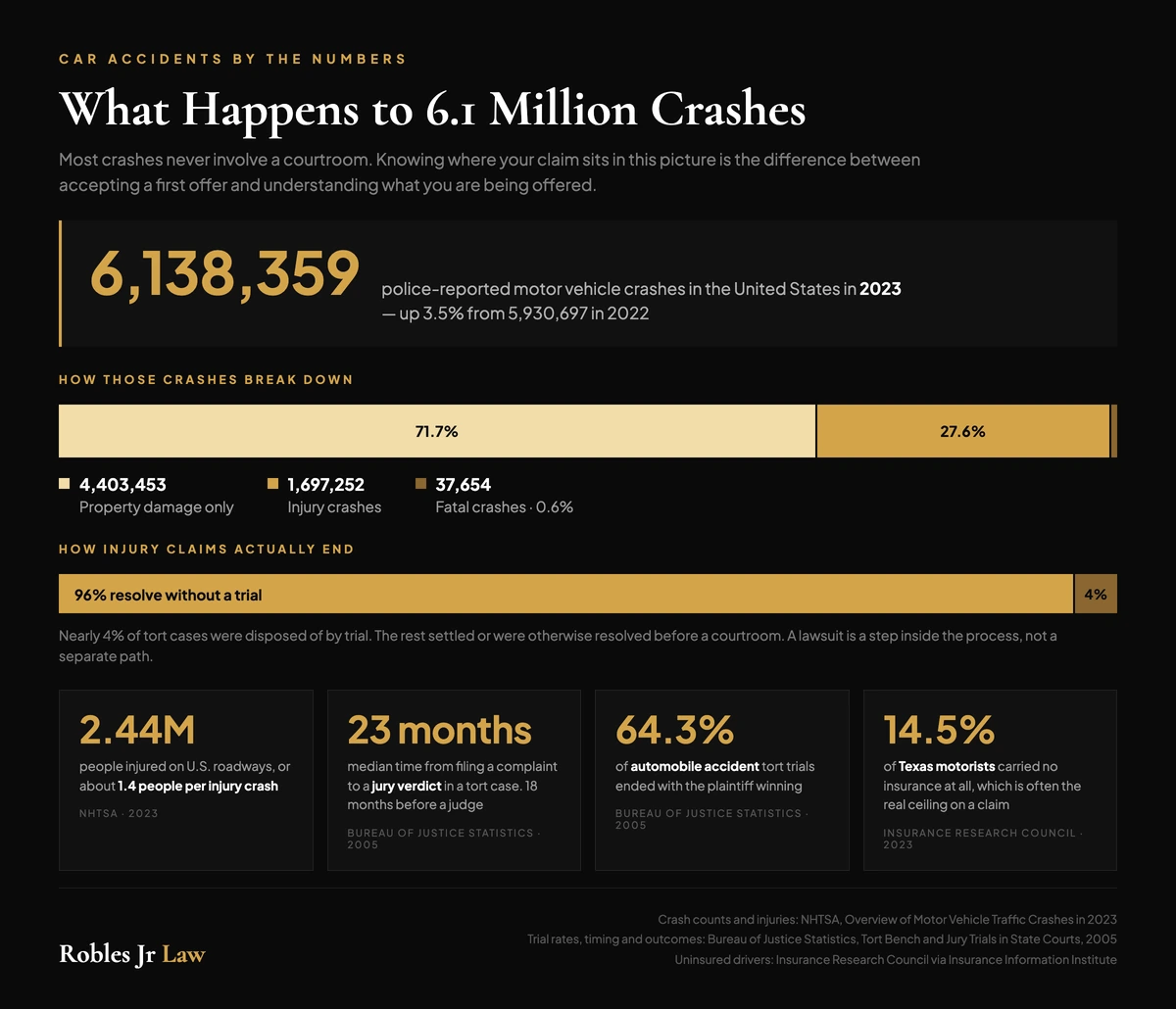
Most claims never see a courtroom, which is worth knowing before anyone uses the word lawsuit at you.
If it feels crude to reduce a bad few months to a figure, that is because it is. It is also the only mechanism the system has, which is why it is worth understanding rather than guessing at.
How long is this going to take?
Most claims take months rather than weeks, and the biggest factor is usually your own medical treatment. A claim is hard to value properly until your doctors know where you are going to land.
Roughly how it goes:
- Treatment. Everything waits on this, and rushing it usually costs you.
- Records gathering. Slower than anyone expects, because clinics answer requests on their own timetable.
- The demand. This is when the claim first gets a number attached.
- Negotiation. Back and forth, sometimes for weeks.
- Filing suit, only if the offer stays unreasonable. Most filed cases still settle.
Two deadlines the insurer has to meet, both from the Texas Department of Insurance. It has 15 business days to acknowledge your claim, and 15 business days after it has what it needs to decide whether it will pay, extendable by 45 days if it explains why.
Those are business days, not calendar days. A claim that feels stalled at three weeks may still be inside the rules, which is genuinely annoying but useful to know before you start chasing it.
Is there a deadline I could miss?
Yes. Texas puts a hard time limit on filing an injury lawsuit, and once it passes the claim is generally gone no matter how strong it was. There are also shorter notice deadlines in some situations, such as a crash involving a government vehicle.
What this means in practice:
- The clock starts around the date of the crash, not the date you realised how hurt you were.
- Settlement talks do not pause it. An insurer being slow is not an extension.
- Some situations have much shorter notice windows, and those are easy to miss without knowing they exist.
Ask what your specific deadline is at the first meeting. It is a thirty-second question with a permanent consequence, and it is the single most important thing to get right early.
What about my car itself?
Vehicle damage runs on a separate track from your injury. It usually moves faster, and it is the part people most often handle without help.
What the car side can cover:
- Repairs, or the vehicle’s value if it is written off.
- A rental while yours is off the road.
- Lost resale value, because a repaired car is worth less than one that was never wrecked.
That last one gets missed constantly. Two identical cars, one with a collision on its history, do not sell for the same money, and that gap is a real loss even after a perfect repair.
What if the insurance company calls me first?
They usually will, and often quickly. You do not have to give a recorded statement to the other driver’s insurer on the spot, and you do not have to accept the first offer.
What to keep in mind:
- You can say you are not ready to give a statement yet. That is a complete answer.
- An early offer reflects today’s bills, not treatment you may still need.
- Signing a release usually closes the injury side permanently, even if symptoms appear later.
- Be accurate about injuries, not optimistic. “I feel fine” said three days in can be quoted back at you for months.
The adjuster on the phone is usually perfectly pleasant. That is the job. It does not make them neutral, and it does not mean you have to answer everything right now.
What does it cost if I do hire someone?
Nothing up front. The attorney fee comes out of the recovery, and there is no attorney fee if there is no recovery.
Keep two buckets straight:
- The fee is the percentage the firm earns.
- Case expenses are what the case spends: record fees, filing fees, depositions, experts.
The American Bar Association notes that win or lose, a client will probably still pay court filing fees, the costs related to deposing witnesses, and similar charges. Many firms absorb expenses on a case that recovers nothing, but that is a policy rather than a rule. Ask, and get it in the agreement.
How long should a car accident lawyer free consultation take?
A typical car accident lawyer free consultation runs 20 to 45 minutes. A very short call usually means the firm is screening, and a very long one usually means the facts are complicated, not that the case is better.
What a good 30 minutes looks like:
- You describe the crash without being rushed, about 10 minutes.
- They ask follow-ups about treatment, coverage and fault, about 10 minutes.
- They give you a read, including what concerns them.
- You ask your questions, including the fee question above.
- They explain next steps and let you decide later.
If nobody asked about your medical treatment, the meeting was not a real evaluation.
Conclusion
One last thing before the summary. Getting hurt by somebody else’s driving is an unfair thing to happen, and the paperwork that follows does not care how you feel about it. Asking questions is not being difficult. It is how you find out where you stand.
- A car accident lawyer free consultation costs nothing and commits you to nothing.
- Bring what you have, and go even if you have almost nothing.
- Ask what is weak about your case, and how the fee treats expenses.
- Check your own policy for personal injury protection and uninsured motorist coverage.
- You are allowed to leave and think about it.
- Sometimes the right answer is that you do not need a lawyer.
Robles Jr Law offers a free consultation across Fort Worth, Richardson and San Antonio. Bring your questions and leave with a straight answer either way.