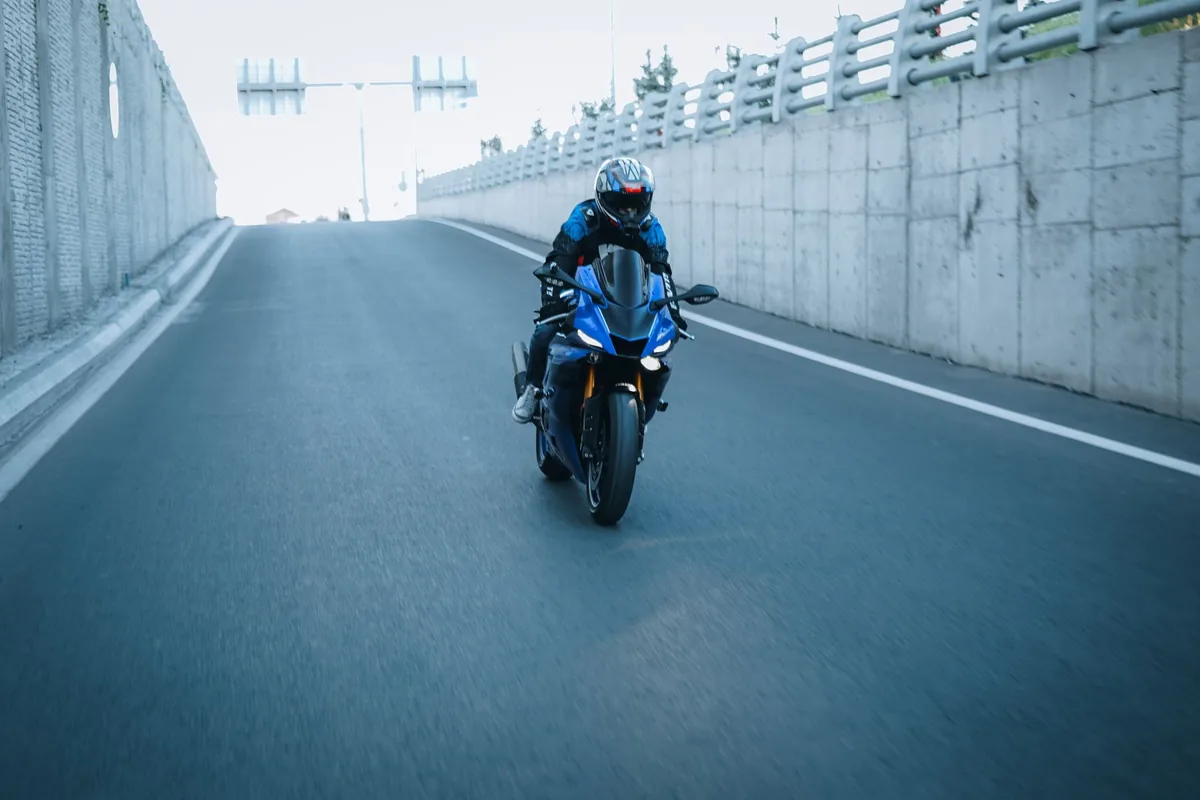
Before an adjuster has read a single medical record, somebody has already decided you were riding too fast. Jose Robles Jr is an Air Force combat veteran and a Richardson motorcycle accident lawyer who takes that assumption apart with evidence, for riders hurt on Central Expressway, the Bush Turnpike and the roads between them.
A Richardson motorcycle accident lawyer helps injured riders recover medical costs, lost income, and money for pain, lasting limits and scarring. Texas only requires helmets for riders under 21, and not wearing one is not proof you caused a crash. You can still recover as long as you were not more than half to blame.
Why do motorcycle claims start at a disadvantage?
Because the rider gets judged before the evidence does. Insurers know that many adjusters, and many jurors, arrive with an assumption that motorcyclists ride recklessly, and they build the file around it.
You can hear it in the first phone call. The questions are about how fast you were going, whether you were filtering between lanes, what you were wearing, whether you had a helmet. None of them is about the driver who turned across your lane. They are about nudging your share of the blame upwards, because Texas law gives the insurer a very specific reason to try.
In Texas you recover nothing if you are found more than half responsible. Below that line your compensation is reduced by your share. So every percentage point an adjuster can attach to a rider is money saved, and past the halfway mark the claim disappears entirely. That one rule explains almost everything the other side does in the first month.
Answering it takes the physical record rather than the story: photographs before the bike is moved, the damage pattern on both vehicles, the sight lines at the junction, and where the debris actually landed. Riders who assume the police report settles it are often surprised, because a report is one officer's opinion formed after the fact, not a finding anyone is bound by.
Do you have to wear a helmet in Texas?
Only riders and passengers under 21 must. Adults may ride without one if they have done an approved course or carry qualifying health cover.
This is the rule most riders have heard about and almost nobody has actually read. Here is what it says.
The Texas helmet rule, in plain words
Under 21
A helmet is required, with no exceptions.
21 and over
You may ride without one if you have finished an approved rider training course, or if you carry health cover that pays for injuries from a motorcycle crash.
Being pulled over
An officer is not allowed to stop you purely to check whether you did the course or carry the cover.
In a claim
The helmet law is a traffic rule. It says nothing about injury claims, and not wearing one is not evidence that you caused a crash.
One correction worth making, because it appears on a great many Texas law firm pages: the law names no dollar amount of health insurance. The frequently repeated figure of ten thousand dollars in cover is not in it. What it asks for is a health plan that pays for injuries from a motorcycle collision.
If you were legally riding without a helmet and are now being told your claim is worthless, that is a negotiating position rather than the law.
Where do Richardson riders get hurt?
At left turns across traffic, on the US-75 service roads, and at the Bush Turnpike ramps. All three are places where a car driver has to judge the speed of something narrow and moving.
The left turn is the classic. A driver waiting to turn misjudges how fast an oncoming motorcycle is closing, or scans straight past it because the profile is narrow, and turns into the rider's path. It is the single most common serious motorcycle collision anywhere, and Richardson's long signalled crossings on Belt Line, Campbell, Arapaho and Coit produce a lot of them.
The service roads beside Central Expressway create a different problem. Drivers cross several lanes in a short stretch to reach an exit or a business entrance, and a motorcycle in the lane they are crossing into is easy to miss in a mirror.
Motorcycle accidents caused by the road surface itself are the third category, and they are worth investigating properly. Gravel washed onto a bend, uneven paving at a repair, or a badly marked works area can bring a contractor or a public body into the claim. Claims involving public bodies carry written notice deadlines that arrive far sooner than the usual two years, so they need looking at quickly.
What should you do after a Richardson crash?
Get treated the same day, photograph the bike before it is moved or repaired, keep your gear, get the crash report number, and say nothing recorded to the other insurer until you have advice.
Be examined immediately. Adrenaline hides injuries, and a gap before your first appointment is the first thing used to discount a claim.
Do not repair or scrap the bike yet. The damage pattern is evidence of the angle and the speed of the impact. Photograph every side first.
Keep your gear exactly as it is. A scuffed helmet, a torn jacket and damaged boots document the forces involved better than any description.
Get the crash report number. The officer's report is the official record; you do not file one yourself.
Give no recorded statement. You are not required to, and early statements are what the comparative blame argument is built from.
If the crash was weeks ago and none of this happened, the claim is not lost. It has to be rebuilt from what still exists, which is ordinary work.
Why work with Jose Robles Jr after a motorcycle crash?
You talk to the lawyer handling your case, not a rotating queue of case managers. That is the whole model of this firm.
Jose Robles Jr is a decorated Air Force combat veteran with a 95% success rate, $5M+ recovered, 1,000+ cases handled, and a 4.9 star Google rating.
Before becoming a personal injury lawyer, Jose "Joe" Robles Jr served nearly 15 years as an Air Force Military Police officer, including four combat tours in the Middle East, and competed on the All-Air Force Boxing Team. He earned his law degree from Texas A&M University School of Law and spent four years at Bailey & Galyen, rising to Managing Attorney of the Pre-Litigation Personal Injury Department, before founding this firm.
An experienced motorcycle accident attorney expects that bias and gathers the evidence that answers it, instead of discovering the problem when the first offer arrives. That is the difference this makes.
Riders have the same rights as every other road user, and Texas safety laws apply to the driver who pulled out just as much as to the person on the bike. Protecting those rights is mostly planning: knowing what to collect, and collecting it before it is gone. Clients who call in the first week give us far more to work with than those who wait, and hiring someone early costs nothing extra because the fee is a share of the result either way. Injured riders deserve that head start.
If you were treated by a doctor, missed work, or the other driver disputes what happened, yes. Motorcycle claims carry a problem that car claims do not: adjusters and juries often start from a quiet assumption that the rider was going too fast or weaving. Undoing that takes physical evidence gathered early, and sometimes a reconstruction. If you walked away with a scratched fairing and no injuries, handling it yourself is reasonable. The consultation is free either way.
How much compensation can I get for a motorcycle accident?
It depends on your injuries, your treatment, the work you missed and the insurance available, and no honest lawyer quotes a number before reading your records. Texas lets you recover for medical care, wages and earning ability lost, physical pain and mental distress, lasting physical limits, and visible scarring. Riders usually have far larger claims under those last two headings than people in cars, because there is no metal between them and the road.
How long does it take to get a settlement?
It depends on when your treatment ends. Settling before your doctors know whether you need surgery means guessing at what your own claim is worth, so a case usually cannot be resolved responsibly until your recovery has levelled off. Straightforward claims can finish in a few months. Cases involving surgery, disputed fault or a commercial vehicle often run a year or more. Texas gives you two years from the crash to file.
Do I have to wear a helmet in Texas?
Riders and passengers under 21 must. If you are 21 or over you may ride without one if you have completed an approved rider training course or carry health cover that pays for injuries from a motorcycle crash. One detail worth correcting, because a great many Texas law firm pages state it wrongly: the law names no dollar amount of cover. It requires a health plan that covers motorcycle crash injuries, not a specific figure.
Can not wearing a helmet be used against me?
Not to show you caused the crash. A helmet has nothing to do with who failed to yield, and the helmet law is a traffic rule that says nothing about injury claims. What the other side may attempt is a narrower argument: that a head injury would have been less severe with one. That is a medical question answered with medical evidence, and it has no bearing at all on a broken leg, a shoulder rebuild or road rash.
What if the driver says they never saw me?
That sentence is extremely common and it is not a defence. A driver has a duty to look for traffic that has right of way, and a motorcycle is traffic. Failing to see something that was there to be seen is a failure to keep a proper lookout. In practice that statement is often the strongest fact in the rider's case rather than the weakest, because it concedes the driver turned or pulled out without knowing what was coming.
What if the driver who hit me had no insurance?
Your own uninsured and underinsured motorist cover may respond, and it is worth checking even if you believe you declined it, because a Texas insurer has to offer it and your refusal has to be in writing. Texas only requires a driver to carry $30,000 of injury cover per person, which one air ambulance ride can use up entirely. Going through every policy that might apply, including household ones, is part of the first meeting.
Injured? You Deserve a Fighter in Your Corner.
No fee unless we win. Call us now or schedule your free consultation online.