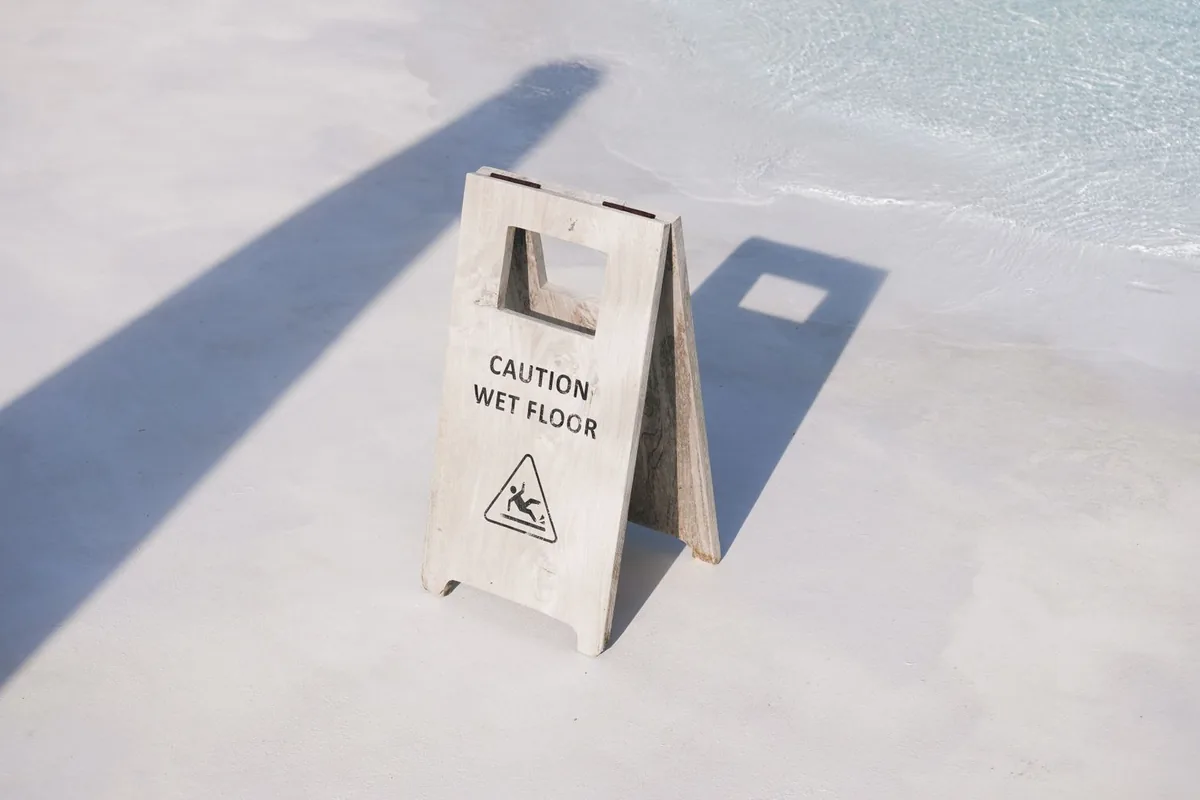
Falling in a store is not a case. Proving the store knew about the hazard is. Jose Robles Jr is an Air Force combat veteran who builds premises claims around the records that show what a property owner knew and when, for people injured across Bexar County.
A San Antonio premises liability lawyer proves that a property owner knew about a dangerous condition, or should have, and failed to fix it. Texas requires four elements: knowledge, unreasonable risk, failure to use reasonable care, and causation. Surveillance footage that proves the first element is often recycled within days. Free consultation, no fee unless we win.
What are the four elements of premises liability in Texas?
Knowledge, unreasonable risk, failure to use reasonable care, and causation. All four must be proven, and the first one decides most cases.
This is the framework Texas courts apply to a claim brought by an invitee, the category that covers customers, hotel guests, and tenants in common areas. Texas courts have applied it consistently for decades.
What a Texas premises liability claim must prove
What Texas courts require an injured visitor to prove.
ELEMENT 1 • Actual or constructive knowledge
The owner or occupier knew about the condition, or it had existed long enough that a reasonable inspection would have found it. This is where most cases are won or lost.
ELEMENT 2 • Unreasonable risk of harm
The condition posed a genuine danger, not the ordinary hazard of walking through the world.
ELEMENT 3 • Failure to exercise reasonable care
The owner did not take reasonable steps to reduce or eliminate the risk, such as cleaning, blocking off, repairing, or warning.
ELEMENT 4 • Proximate cause
That failure actually caused the injury.
Read element one again, because it is the one that ends cases. It is not enough that you fell, and it is not enough that a hazard existed. The question is whether the owner knew, or whether the condition sat there long enough that a reasonable inspection would have found it. A spill that had been on the floor for three minutes and the identical spill an hour later are legally different situations.
That is why "constructive knowledge" becomes the battleground, and why the evidence that settles it, meaning sweep logs, inspection schedules, employee statements, and camera footage, has to be secured before it is routinely destroyed.
Does it matter why you were on the property?
Yes, more than almost anything else. Texas sorts visitors into three categories, and the duty the owner owed you depends entirely on which one applies.
What the property owner owed you
Duty owed under Texas premises law, by visitor status.
Invitee
On the property for the owner's benefit: a customer in a store, a guest at a hotel, a tenant in the common areas. Owed the most protection, including a duty to inspect for hazards the owner does not yet know about.
Licensee
Present with permission but for their own purposes, such as a social guest. The owner must not injure them wilfully and must warn of dangers it actually knows about.
Trespasser
Present without permission. Owed only a duty not to injure wilfully, wantonly, or through gross negligence, with narrow exceptions involving children.
Most claims that reach a lawyer involve invitees, because that is the status of anyone shopping, dining, staying, or renting. It is also the status that carries a duty to inspect, meaning property owners cannot escape responsibility simply by not looking.
Experienced premises liability attorneys start with status for that reason. It determines what the owner had to do, and therefore what has to be proven.
Expect the defense to argue about status anyway. A guest who wandered into a staff-only area, or a tenant injured in a part of the property outside the common areas, will be recharacterized if the facts allow it, because the duty owed to a licensee is far narrower.
What kinds of San Antonio properties produce these claims?
Retail floors, apartment complexes, hotels, restaurants, and parking structures, with the specific hazard varying by property type.
Retail and grocery. Spills, produce debris, tracked-in rainwater at entrances, and merchandise stacked so it falls. Chains typically keep sweep logs, which are excellent evidence when they exist and telling evidence when they do not.
Apartment complexes. Broken stair treads, unlit walkways, defective handrails, pool areas without required fencing, and negligent security claims arising from assaults on the property. These involve maintenance request histories, which frequently show the same complaint filed repeatedly.
Hotels and restaurants. Wet tile near entrances and restrooms, poorly marked steps, and uneven transitions between surfaces. San Antonio's visitor economy along the River Walk and around the convention district generates a steady share of these.
Parking lots and garages. Potholes, wheel stops in walking paths, missing lighting, and drainage that ices in a rare freeze. Ownership is often split between a property owner and a management company, and identifying who controlled the area is part of the work.
Why does surveillance footage decide so many of these cases?
Because it is usually the only objective proof of how long the hazard was there, and it is routinely overwritten within days or weeks.
Most commercial camera systems record on a loop. Depending on the property, the retention window can be as short as a few days. Nothing requires a business to preserve footage simply because someone fell, and nothing stops the loop from running while an injured person waits to see whether their back improves.
A written preservation demand changes that. Once a property owner is on notice that specific footage is relevant to a claim, destroying it is no longer routine record-keeping, and a court can instruct a jury about what the missing evidence would likely have shown. Sending that demand is one of the first things done on a premises case, and it is the step that cannot be recovered later.
Incident reports matter for the same reason. If a manager filled one out on the day, it exists somewhere. If nobody did, that absence is itself informative about how the property handles hazards.
Who will pay is a separate question from who is at fault. Commercial properties carry liability insurance, and it is that insurer, not the store manager, who decides what to pay on these accidents.
If you fell weeks ago and no report was made, the claim is not automatically lost. It has to be built from what remains, which is ordinary work rather than a reason to give up.
Why work with Jose Robles Jr on a premises claim?
You talk to the attorney handling your case, not a rotating queue of case managers. That is the whole model of this firm.
Jose Robles Jr is a decorated Air Force combat veteran with a 95% success rate, $5M+ recovered, 1,000+ cases handled, and a 4.9 star Google rating.
Before becoming a personal injury lawyer, Jose "Joe" Robles Jr served nearly 15 years as an Air Force Military Police officer, including four combat tours in the Middle East, and earned his law degree from Texas A&M University School of Law. Afterward he spent four years at Bailey & Galyen, rising to Managing Attorney of the Pre-Litigation Personal Injury Department, before founding this firm.
Premises cases reward speed and paperwork rather than volume, which suits a practice built to move on a file in the first week rather than the first quarter. For San Antonio clients that means a bilingual team and an office in the South Texas Medical Center off Loop 410.
What are the four elements of premises liability in Texas?
For a claim by an invitee, Texas requires proof of four things: that the owner or occupier had actual or constructive knowledge of a condition on the premises, that the condition posed an unreasonable risk of harm, that the owner did not exercise reasonable care to reduce or eliminate the risk, and that this failure proximately caused the injury. Texas courts have applied this framework consistently for decades. The first element is where most cases are decided.
Are premises liability cases hard to win?
They are harder than most people expect, and the reason is the knowledge element. It is not enough that you fell or that a hazard existed. You must show the owner knew about it, or that it had been there long enough that a reasonable inspection would have caught it. A spill three minutes old is very different legally from the same spill an hour old. That is why evidence gathered in the first days, especially surveillance video and inspection logs, so often decides the outcome.
What is a premises liability attorney?
A lawyer who handles injuries caused by the condition of someone else's property rather than by a vehicle or a product. The work centers on proving what the property owner knew and when, which means obtaining incident reports, sweep and inspection logs, maintenance records, prior complaints about the same hazard, and camera footage before it is recycled. Slip and fall, negligent security, falling merchandise, unsafe stairs, and inadequate lighting claims all fall under it.
Is premises liability under negligence?
Yes. Premises liability is a form of negligence, but Texas treats it as a distinct theory with its own elements, and the distinction matters procedurally. The Texas Supreme Court has warned plaintiffs against submitting a premises case to a jury on a general negligence instruction. A claim about a dangerous condition of the property is a premises liability claim; a claim about an ongoing activity that injured someone is a negligent activity claim. Pleading the wrong one can defeat an otherwise valid case.
How long do I have to file a premises liability claim in Texas?
Two years from the date of injury under Texas law. The practical deadline is far shorter. Surveillance footage at most San Antonio retail properties is overwritten on a cycle measured in days or weeks, and once it is gone the knowledge element becomes much harder to prove. A written preservation demand sent early is often the difference between a provable case and a disputed one.
What if I was partly at fault for my fall?
You can still recover as long as you were not more than half to blame. Texas law bars recovery only when you were more than half to blame, and below that line damages are reduced by your share rather than wiped out. Expect the property owner to argue that the hazard was open and obvious or that you were distracted, because those arguments are aimed directly at that threshold.
Can I sue an apartment complex for an assault on the property?
Sometimes. A negligent security claim argues that the property owner knew of a foreseeable risk of criminal activity and failed to take reasonable precautions such as functioning locks, adequate lighting, working gates, or security personnel. Foreseeability usually rests on the property's own history and the surrounding area's crime data. These cases are document-intensive and time-sensitive, because prior incident reports and camera footage are the proof.
Injured? You Deserve a Fighter in Your Corner.
No fee unless we win. Call us now or schedule your free consultation online.